Artificial Intelligence and the “Way to Better Work”
A paper on a human-centered approach to work in the age of AI
By: Robert O. Martichenko

Jump to Section...
A New Beginning
The future of work will not be decided by technology alone, but by whether leaders choose to place human dignity at the center of progress.
We are standing at the edge of one of the most significant transitions in the history of work.
Artificial intelligence (AI) is already reshaping how work is done, how decisions are made and how value is created across nearly every industry. When used thoughtfully, it has the potential to reduce waste, improve quality and free human energy for higher-value contributions. When introduced carelessly or without regard for people, it will just as quickly accelerate disengagement, mistrust and social fragmentation.
The defining question is not whether artificial intelligence will transform work, as this outcome is already inevitable. Rather, the real question is whether leaders will protect the dignity of work and the humanity of working people while this transformation unfolds.
This is not a philosophical question. It is a structural one with direct implications for organizational stability, performance, growth and long-term health. The way work is designed, experienced and executed matters more now than it has in any other generation.
Much of today’s AI conversation centers on capability, speed, scale and efficiency, along with discussions about removing mass numbers of people from processes altogether. These conversations may not be wrong, but they are certainly incomplete. They overlook the reality that for many people, work is a part of their societal contribution, where identity and self-worth are reinforced, skills are developed, life progress is experienced and dignity of a life well lived is built upon.
When AI discussions frame people primarily as a cost to be eliminated, we send a destabilizing signal. This signal tells people that their value is in question and that their contribution is conditional and negotiable based on a spreadsheet exercise. Over time, this undermines trust not just in leadership, but in the organization itself.
It is not reasonable or realistic to expect hard-working people to quietly accept this message. Once human dignity is questioned at scale, fear enters the system, participation retreats and rebuilding trust becomes far more difficult than preserving it would have been.
Therefore, this moment requires pause, reflection, and directional intention.

Why This Change Is Fundamentally Different
The AI transformation is different because implementation speed has outpaced workplace stability, making people, not technology, the critical factor for sustainable progress.
Every major wave of technological change reshaped work, but each followed a familiar pattern. Early industrial work operated as job shops, where skilled individuals controlled production end to end. The assembly line then reorganized work into repeatable tasks, dramatically increasing output while reducing dependence on individual craft. Automation followed, embedding machines into linear processes to increase speed and consistency. Electrification and digital control systems further accelerated scale and a drive for continued efficiency.
However, each of these transitions unfolded over relatively long time horizons. Organizations had years, often decades, to adapt. Even so, many failed to retrain their existing workforce and instead of developing people alongside new technologies, companies restructured, terminated employees, attempted to hire workers who already possessed the required skills, often pulling talent from competitors or adjacent industries. Disruption occurred, but the pace of change allowed systems and societies time to absorb it.
Artificial intelligence arrives under very different conditions. The speed of change is unprecedented, but more importantly, it is being layered onto systems that remain fundamentally unstable. While decades of investment in ERP, MRP, DRP, and planning technologies promised stable inputs, predictable outputs and integrated supply chains, in practice, this work remains unfinished. Data is often inaccurate, processes are fragmented and decision-making remains disconnected across functions. Flow from customer demand through operations to supplier management still does not truly exist. Stability of process and hence stability of people systems has not been achieved.
What organizations continue to misunderstand is how stability is achieved. Stability does not emerge from technology alone; it emerges when business functions are connected end to end, with people actively engaged in the process, understanding tradeoffs, correcting problems at the root and learning together.
Flow, both physical and informational, is not a technical achievement, it is a human and organizational outcome achieved by connecting people to people and people to process.
AI will now accelerate this unresolved instability. When advanced technologies and automation are applied to broken processes and unreliable inputs, they do not create clarity. They amplify noise, poor decisions scale faster and errors scale in tandem, while frustration and confusion scale exponentially.
This is what makes the current transition fundamentally different. AI is not arriving after current systems have been stabilized, it is arriving while instability remains unresolved, making human connection inperitive for sustainable progress into the future.

Process Drift and Entropy
When human energy is withdrawn from a system, disorder is inevitable and no amount of control or technology will compensate for the loss.
When people feel invisible, unheard or disposable, organizations begin to behave like closed systems. Participation fades, trust erodes, energy stops entering the system and entropy accelerates.
In practical terms, entropy shows up as process-drift. Process-drift is what happens when work slowly stops being done the way it was intended and designed. Standards soften, handoffs weaken, feedback loops break down, performance diminishes and decisions become inconsistent and increasingly short-term. Small problems are tolerated instead of addressed until the system moves to disorder and quietly loses its ability to produce the outcomes it once did.
In closed systems, entropy is inevitable. Yes, structure can be rearranged, policies added and controls tightened, but order itself cannot be restored. The good news is, workplaces and societies are not closed systems by nature; they only begin to behave this way when learning slows, participation fades and people stop believing their contribution matters. This drift is rarely caused by bad intent or lack of effort. It is the natural direction of any living system that is no longer being actively energized.
On the other hand, when people feel respected, heard and included, organizations behave like open systems. Energy flows into our work, problems surface earlier and improvement becomes part of daily life. Process-drift still exists but it is recognized and corrected before it causes real harm.
Organizations are living systems and like all living systems they require continuous energy to remain healthy. This energy comes from trust, learning, participation and the shared belief that organizational improvement is possible.
The antidote to process-drift is not leadership controls, new frameworks or the implementation of new technologies. The antidote to process-drift is Human energy.

Adaptive Change, Emergent Change, and the Nature of the System
Treating a complex system as simple will turn solutions into problems and change into instability.
Much of the tension surrounding artificial intelligence comes from how organizations are trying to change in response to it. Many leaders believe they are making rational, adaptive decisions by reacting to new capabilities and competitive pressures. While adaptive, linear change is necessary, it assumes the underlying current state of the business system is well understood, stable and fundamentally sound.
Emergent change is different. It arises in complex systems where cause and effect cannot be cleanly separated and where outcomes are shaped by relationships, feedback loops and shared interdependencies. Emergent change is unpredictable, where the sum of the parts looks nothing like the parts themselves. The probable set of outcomes of artificial intelligence sit firmly in this category.
Many organizations are reacting to AI as if it were simply another adaptive challenge, treating it as both the driver of change and the solution to existing problems. In other words, we are making changes because of the AI challenge and AI is the perceived solution to meet the challenge. The disease and the cure are one and the same. And we know from experience, when the remedy and the sickness begin to look the same, it is a signal of misunderstood complexity.
In complex business systems, inputs do not create predictable outputs. Leadership interventions reshape behavior, behavior reshapes the system and consequences appear far from their origin. Yet many of the problems AI is expected to solve stem from eroded trust, disconnected systems and declining team member participation. If AI is introduced into environments already suffering from low trust and process-drift, it will amplify these conditions rather than resolve them and its efficacy as a tool for performance acceleration will be compromised from the start.
Artificial intelligence will not replace organizational Human energy. It will depend on it.
This is why AI must be treated as part of a business ecosystem rather than a standalone initiative. Ecosystems remain healthy only when energy is balanced and continuously replenished. In nature, this energy comes from the sun. In organizations, the only renewable source of energy is people, specifically the energy created through leadership, learning and team member participation.
When leaders invest energy into people, systems remain open, learning accelerates, feedback loops strengthen and emergent change becomes leveraged rather than destabilizing. When this energy is absent, systems close, entropy increases and even well-intended technology becomes a source of strain and a catalyst to organizational disorder.
What we are experiencing with AI and other workplace disruptions is not a black swan event. It is better understood as systemic convergence within a complex system where multiple known forces interact and reinforce one another. Convergence means these forces do not act in isolation; their relationships compound, creating effects that are larger and fundamentally different than any single factor alone. When this interaction reaches a threshold, the system enters a phase transition, a point at which the old rules no longer hold and the system begins reorganizing into a new state. Artificial intelligence, demographic shifts, workforce availability, cultural expectation and economic pressures are not simply occurring at the same time. Collectively, they are pushing the system across a convergence threshold.
Artificial intelligence will not replace organizational Human energy. It will depenTherefore, the question is not ‘how will AI impact a particular process in the business,’ but rather ‘how will using AI for a particular process impact our people in the business.’d on it.
In this environment, organizations that are not actively developing their people and do not have an internal platform to support learning, participation and growth at scale, will be left behind. Technology may accelerate change, but only people can navigate it. This is the defining leadership challenge of this transition.

The Dignity Economy
In a world where efficiency is commoditized, dignity becomes the true source of differentiation.
For more than a century, organizations have operated within what can be described as the Efficiency Economy. Value is defined by lower cost, higher output, faster execution and the ability to do more with fewer people. Leaders are trained, rewarded and promoted based on their ability to break work into small parts, optimize those parts independently and reduce labor and inputs wherever possible. This reductionist mindset did not emerge by accident; it was taught, reinforced and institutionalized across generations of management practice. And in many ways it seemed correct, as productivity increased, access to markets expanded and industries scaled at unprecedented levels.
However, the same logic that enabled growth will now reveal its limits. As technology and artificial intelligence promise to make efficiency widely accessible, a logical conclusion is that efficiency will stop being a competitive advantage and will become a commodity. Barriers to entry will fall in many industries, competitors will multiply and prices will face relentless downward pressure.
In this environment, doing more with less no longer differentiate organizations; it will simply accelerate commoditization.
A simple example illustrates this shift. When customers learn that a supplier has laid off tens of thousands of people in the name of AI efficiency, the reaction will rarely be admiration. More often it will trigger a call asking for a price reduction because if the same product or service is delivered with far fewer people, customers reasonably expect the savings to be shared. If the answer is “no”’ our request, we will look elsewhere for the service. In technology-enabled markets, alternatives will be easy to find and efficiency quickly becomes a source of margin erosion rather than market growth.
At the same time, large-scale workforce reduction will send a cultural disruption signal. People are not only workers; they are also customers, citizens and participants in the broader economic system. When organizations optimize by removing people rather than investing in their contribution, trust in the entire system erodes.
Participation will decline, fear will enter the system and workplace instability will follow through disengagement, reputational damage, labor organizing efforts and social backlash. These are not moral failures alone; they are economic ones.
In this environment, organizations that are not actively developing their people and do not have an internal platform to support lThe Dignity Economy will emerge because organizations must now compete on something fundamentally different. Value shifts away from features, speed and cost alone, all of which are increasingly commoditized. Instead, organizations must differentiate through stability in volatile environments, trust built through consistent and humane behavior, meaningful participation for employeesearning, participation and growth at scale, will be left behind. Technology may accelerate change, but only people can navigate it. This is the defining leadership challenge of this transition.
and customers, resilient systems that recover rather than collapse under pressure and the ability to create human energy rather than drain it.
This transition will be difficult. Organizations have been trained to equate getting better with efficiency gains measured by labor reduction.
Moving into the Dignity Economy requires unlearning deeply embedded habits and metrics.
This will demand new ways of measuring success that value relationships, trust, learning and long-term system health, understanding that these input factors lead to improvement, innovation and sustainable organizational performance.
The difference is how improvement is defined. In the Dignity Economy, organizations get better not by reducing humanity but by designing systems where humanity becomes the source of resilience, adaptability and sustainable value. Efficiency remains necessary but dignity becomes the guiding principle.

Making the Invisible Seen
For too long we have described work using labels that quietly diminish some of the most important contributors in our society.
We talk about hourly versus salaried, blue-collar versus white-collar or repetitive tasks versus knowledge-based work, as if these distinctions explain human value. They do not. What they obscure is how much of society depends on work that must happen now, not later, and cannot be postponed without immediate consequence.
The people most affected by this language are often the least visible. People who keep hospitals and facilities sanitary, nurses who monitor patients’ minute-by-minute wellbeing, teachers who guide daily classroom learning every day, construction workers who make buildings safe, waste-collection crews who prevent public health crises, first responders who show up at moments of chaos and parents and caregivers who raise children, often without recognition or compensation. These roles are not peripheral. They are urgent, critical and essential.
This imbalance is not accidental. Much of our modern economy has been shaped around financial flows where value is easier to measure, monetize and optimize. As a result, jobs tied to spreadsheets and financial gains are often compensated far more than jobs tied to care, human progress and community responsibility. Yet if waste is not collected, if children are not raised, if patients are not cared for or if emergencies are not answered, the entire social system collapses, no matter how sophisticated the plans or how optimized the data.
As we move forward, this will be another profound change for people and organizations.
The Dignity Economy will not only change how we talk about work but how we value and compensate for true value.
Work that is directly connected to humanity; urgent, presence-dependent and consequential, must no longer be treated as secondary. It must be recognized, rewarded and respected in ways that reflect its true importance.
The future of work will not be defined only by efficiency or data consolidation. It will be defined by how well we honor the people whose work keeps society functioning safely.
Meaningful Employment Environments
Work that sustains human life is not marginal; it is the foundation of a healthy society.
Meaningful Employment Environments begin with foundational commitments to people.
First, organizations must provide for fundamental Human needs. Dignity and trust cannot exist when people are in survival mode. If individuals are worried about their psychological safety, basic respect, financial stability or whether their opinion will be punished, their energy is consumed by self-preservation. In this state, learning shuts down, participation becomes risky and personal advancement feels out of reach.
Providing fundamental needs is not charity or organizational indulgence; it is a responsible element of system design. Organizations that ignore this reality pay for it through high turnover, low engagement, more workplace errors and less innovative ideas. Organizations that address basic fundamental needs directly unlock energy that would otherwise be lost to fear and team member burnout.
The bottom line: human energy is good for business. People and profit are not a friction-point, they are two sides of the same coin.
Meaningful Employment Environments require a path for learning. Learning is how organizations evolve to grow and remain open systems. When learning slows or stops, process-drift accelerates. When learning is active and embedded in daily work, systems continuously reorganize toward more ordered states.
Learning cannot be confined to classrooms or annual training cycles. It must happen in tandem with the work, through real-time participation with authentic leadership support. Learning reinforces dignity because it treats people as capable, growing contributors rather than a cost to reduce.
Meaningful Employment Environments depend on participation. Participation is the primary way energy enters a system. It is not suggestion boxes or surveys, it is the expectation that if you are part of the system, you are part of improving the system.
Leadership is no longer defined by certainty and having all the answers, but by the ability to build trust, participation and workplace improvement.
When people participate, they improve the system they work within and they take responsibility for outcomes beyond their functional role. This is how order and stability re-emerges in complex systems. Yet, participation cannot be mandated; it must be invited and protected through trust and consistent leadership behavior.
Meaningful Employment Environments create personal advancement. Meaning is not static, it is directional, allowing people to see their effort today connects to who they are becoming tomorrow. Advancement does not only mean promotion, it also means growth in skill, confidence, contribution and personal agency.
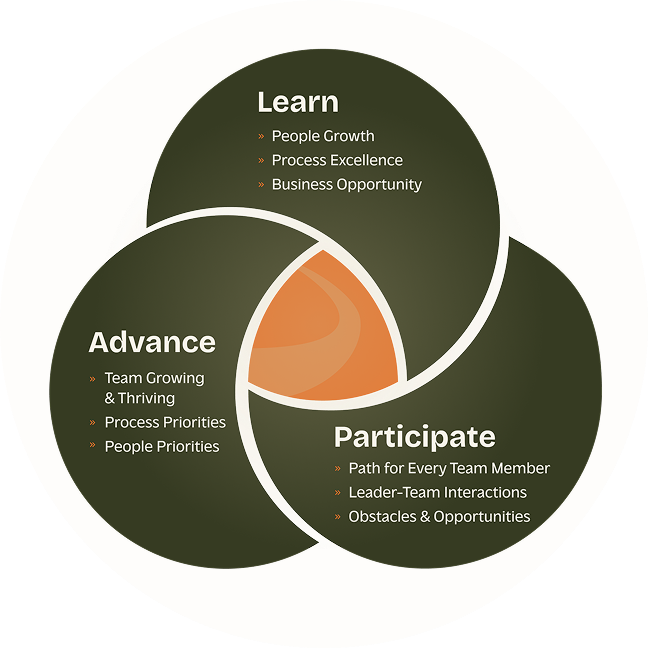
Together, these elements form the Learn, Participate, Advance loop. Learning enables participation, participation drives improvement, improvement creates advancement, advancement renews meaning and meaning fuels further learning.
More about Meaningful Employment EnvironmentsTM
A Meaningful Employment Environment (MEE) is a workplace where people thrive because organizational decisions, leadership behaviors and team member participation are guided by dignity and meaningful work. It is designed to meet the modern challenges of a shrinking workforce, changing employee attitudes and the recognition that people have choices. Where trust has been established, fundamental needs are being met, the environment is participative and the work is meaningful.
The MEE Framework

Build Trust

Meet Fundamental Needs

Create a Participative Environment

Improve the Work
MEE Concept: The Declining to Thriving Status
The Declining to Thriving Status is also important because it shows the progress we want to accomplish in our work building a MEE. We have learned that people are in one of four places at work:

- Declining: I will be leaving as soon as possible.
- Surviving: I will stay until I find something better.
- Growing: I think this will work out.
- Thriving: I can’t imagine being anywhere else.
The Declining to Thriving Status exists across all occupations, all job titles, and all levels of an organization. Whether you are the CEO or a front-line team member, you can identify with and place yourself somewhere on the path. It is important for the people and the organization for all people to move from their current condition to Thriving!
This Learn, Participate, Advance loop represents the Work of Work. Creating visibility and commitment to this loop is the Way to Better Work.
When this loop is intact, process-drift slows and trust grows. When this loop breaks, disorder accelerates, regardless of systems or technology in place. Artificial intelligence will not change these Human truths, but rather, it will amplify them.

Human Leadership
Dignity survives only when leaders consistently act as if people ARE the system and not a cost within it.
There is a growing awareness that leadership can and should be more human. Organizations are stronger when leaders are intentional about how they show up for others, especially in moments of uncertainty and change. We must remember that every decision about AI either strengthens or erodes dignity.
Leadership requires non-negotiable principles of grace, respect, humility and trust. This means remembering people carry more than we can see, treating every role as essential, learning alongside others and being honest about uncertainty while aligning words with actions. The human experience is certainly unique, but it is that uniqueness that allows people to contribute to the workplace in meaningful and, often, unexpected ways.
There is no playbook for the environment we are navigating. No leader has perfect answers. The challenges are complex and interconnected and leadership today is less about certainty and more about integrity, presence and learning together. We must know that human dignity is deeply connected to our work. Dignity comes from knowing work matters, from participating meaningfully and from seeing how contribution connects to something larger than oneself. It is reinforced when people are trusted to improve their work and succeed in all aspects of life.
People are not a problem to solve, they are a unique resource to make the organization stronger.
Dignity is also tied to self-worth. The ability to provide for loved ones, to be counted on and to feel pride in one’s work remains central to how people experience life. When the workplace undermines these needs, fear enters the system and entropy accelerates, leaving people anxious, frustrated and withdrawn.
This is no way for us to treat each other. There is a better way.

What Organizations Must Do Now
We are entering a period of profound transformation. This transformation will test our institutions, our leaders and our assumptions about work.
Before scaling AI, leaders must understand whether dignity and meaningful work are present in the current environment. Without this baseline and a commitment to people, AI will amplify existing problems.
Organizations must align around a clear true north for dignity and meaningful work that guides technology decisions and leadership behavior.
We must also build the infrastructure to support people’s growth at scale. Learning, participation and continuous improvement cannot rely on individual effort alone. A scaled platform is required to make learning visible, participation embraced, process excellence routine and people growth a natural result.
AI must be integrated into this broader system of people growth and process excellence, not isolated as a standalone initiative to head-hunt work and eliminate people. To fully realize its value, AI must complement people in the workplace rather than compete with them. Leaders must commit to continuous reflection, effective communication and directional intention, recognizing that dignity requires ongoing care and energy.
AI cannot be the tail wagging the dog.

Walking the Talk
Perhaps it is time to change the term Human Resource to Human Respect.
No matter how you view the world from a leadership perspective, whether you are inclined to lead with ‘people first’ or ‘efficient first’, the reality is that action is no longer optional. We are entering a perfect storm formed by the rapid disruption of artificial intelligence, a shrinking workforce driven by demographic aging, shifting attitudes about work, where people choose to invest their energy and a host of other interconnected forces reshaping our economy and society.
Perfect storms are not black swan events; they are what happens when multiple, visible variables converge in ways we did not fully anticipate. That is what is unfolding now. Every leader must take notice because without people, there is no work, and without work, there is no value creation. Profit does not exist in isolation. It is created by people, through people and for people. The choices leaders make in this moment will determine not only organizational outcomes but whether work remains a source of dignity, stability and shared progress in the years ahead.
It is easy to understand why many leaders will not embrace the concept of a Dignity Economy. This is a big leap from decades of believing what is correct. However, if dignity is regarded as negotiable, workplace unrest will follow. If participation is treated as optional, entropy and process-drift will accelerate. If people feel erased and invisible, systems will respond accordingly. This is not good business.
We cannot allow working people to feel as if they are the enemy. If this happens, working people will certainly have a vote in the battle and the battle will result in extreme workplace instability. This will in turn result in working people coming together to produce a unified voice rejecting the assault on their dignity.
As leaders we need to invest energy where it matters; by building trust, learning, participation and meaning. Hopefully we can do this in a way that artificial intelligence can become a force for renewal rather than division.
Dignity will not survive automation by accident. It will survive only where leaders choose to treat people as the primary source of energy in the system.
This is not about making process-drift disappear. It is about understanding it, respecting it and designing systems that remain open enough for people to keep doing what humans do best: learn, participate and advance together.
Human dignity must remain our single priority.

About Us
Robert Martichenko
Robert Martichenko is a visionary business leader and the Board Chair of TrailPath Workplace Solutions. He is an entrepreneur, thought leader, professional education instructor, business author, poet, and novelist.
A continuous thought leader, Robert sits on multiple advisory boards, including chair for the American Logistics Aid Network (ALAN) and the executive board for the Association for Manufacturing Excellence (AME). In addition, he has received several prominent industry awards, most notably, the distinguished service award from the Council of Supply Chain Management Professionals (CSCMP), the highest recognition achievable for professionals in the supply chain industry.
Robert has written and co-written award-winning business books and multiple articles related to Lean, enterprise excellence, supply chain management and leadership. In addition, he published a fiction novel, “Drift and Hum,” which won multiple awards, including the IBPA Benjamin Franklin Gold Winner award for best first book fiction. He has also written poetic verse for two children’s books.
He is an active member of the business community and is passionate about the people side of Lean, enterprise excellence, the future of workforce development and creating meaningful employment environments. Martichenko complements his professional experience with a bachelor’s degree in mathematics, an MBA in finance, and a Six Sigma Black Belt.

TrailPath
The ideas explored throughout this paper reinforce a critical reality: the future of work will be decided by how intentionally organizations connect people, process, and technology in ways that protect dignity and enable meaningful participation. Artificial intelligence will not fix broken systems; it will simply amplify what already exists, for better or worse.
The challenge now is translating these principles into daily practice by intentionally designing how work gets done and improved as change accelerates.
TrailPath Workplace Solutions exists to do just that: to improve the world by improving work itself.
We believe better work benefits everyone: people thrive, processes improve and results compound over time. We help operations-led organizations reach their goals by aligning how leaders lead, how people work and how the organization supports them with easy-to-implement technology and proven practices.
Through our platform, NxtPath, we bring together people and processes so organizations can move from reactive firefighting to continuous improvement, creating stability, stronger leadership and predictable performance. The challenges may be complex but the path forward can be practical and clear.
For organizations interested in exploring how these ideas translate into practice, we welcome the opportunity to continue the discussion.